A Norman door is a door which is unintuitive to operate. It is named, in jest, with a reference to Donald Norman whose influential book The Design of Everyday Things discusses (among many other things) the topic of doors with unclear "affordances".1
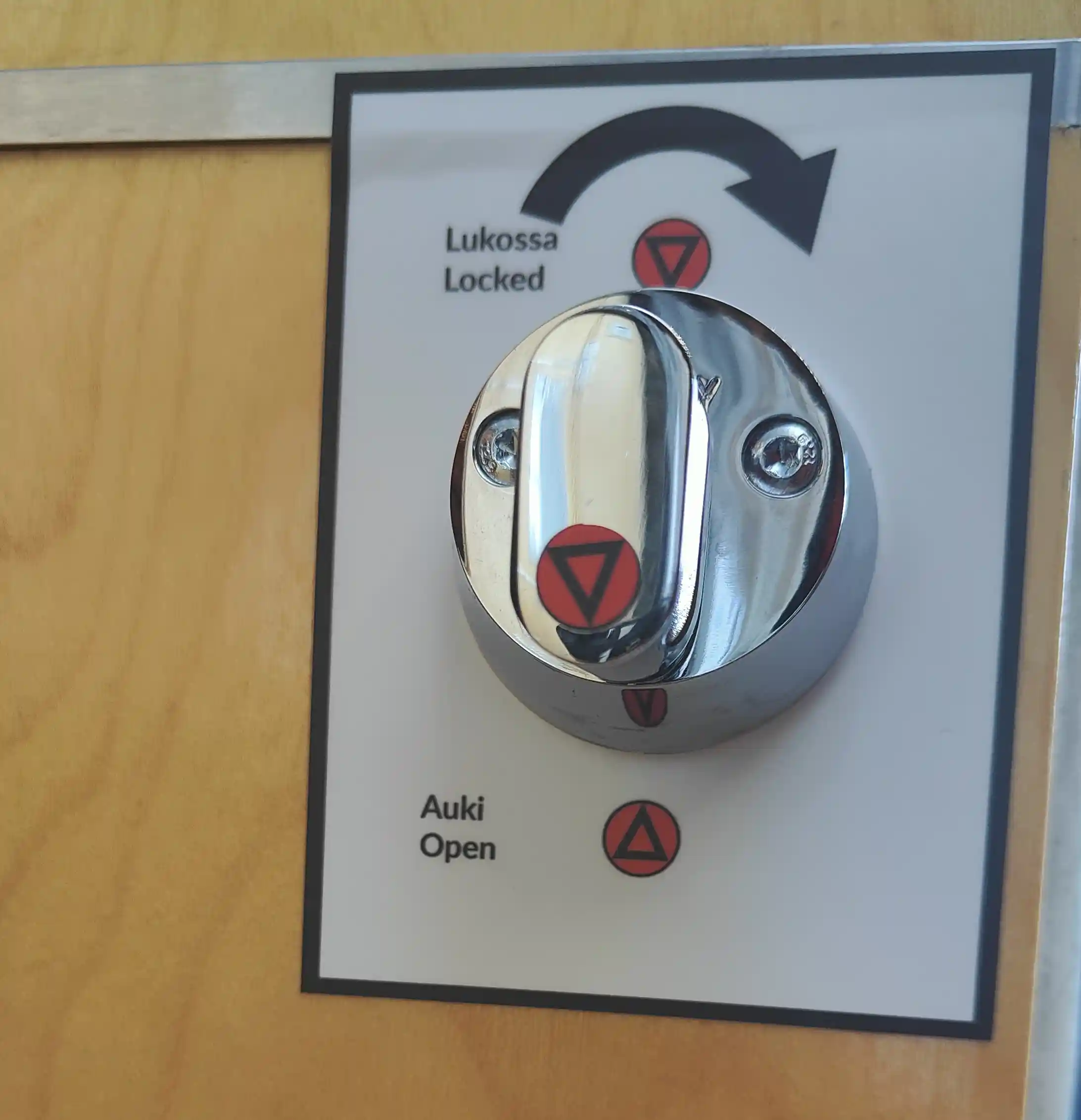
The door lock we see hear is from a large auditorium at the university of Jyväskylä. The door itself was not a Norman door, as it was clear which way to open. But the lock seemed to have caused confusion in the past, as it was evidently necessary to provide quite thorough instructions on how to know if the door is open or locked. Though I would say that the added design is also not the clearest possible choice.
Indeed, if you want to lock the door, you need to turn the knob so that the orientation of the triangle on the knob matches the symbolic-textual description on the outer rim. But instead of having the triangle symbol e.g. in the center of the knob and the explanations on the side or next to each other, the triangle symbol is attached to one end of the knob. This choice indexes that side of the knob as special. When you combine this with the fact that above the knob it says locked and below it says open, one might think that to lock the door you need to turn the specified side of the knob where it says "locked". But instead you have to turn it to the side that says "open", since then the triangle orientations match.
I think this would work so much better with either a centered triangle sticker on the knob or, preferably, switching the "open" and "locked" texts so that the triangle-orientation and knob sticker indexical position would match.
-
Amusingly the Finnish translation bears the title of "How to open impossible doors? The risks of everyday design.". ↩