I recently wrote about a paper discussing called Multilingual Commanding Urgency (MCU), and the sign I discussed there was an opposite of an MCU sign. This time we look at a sign explicitly demonstrating the concept.
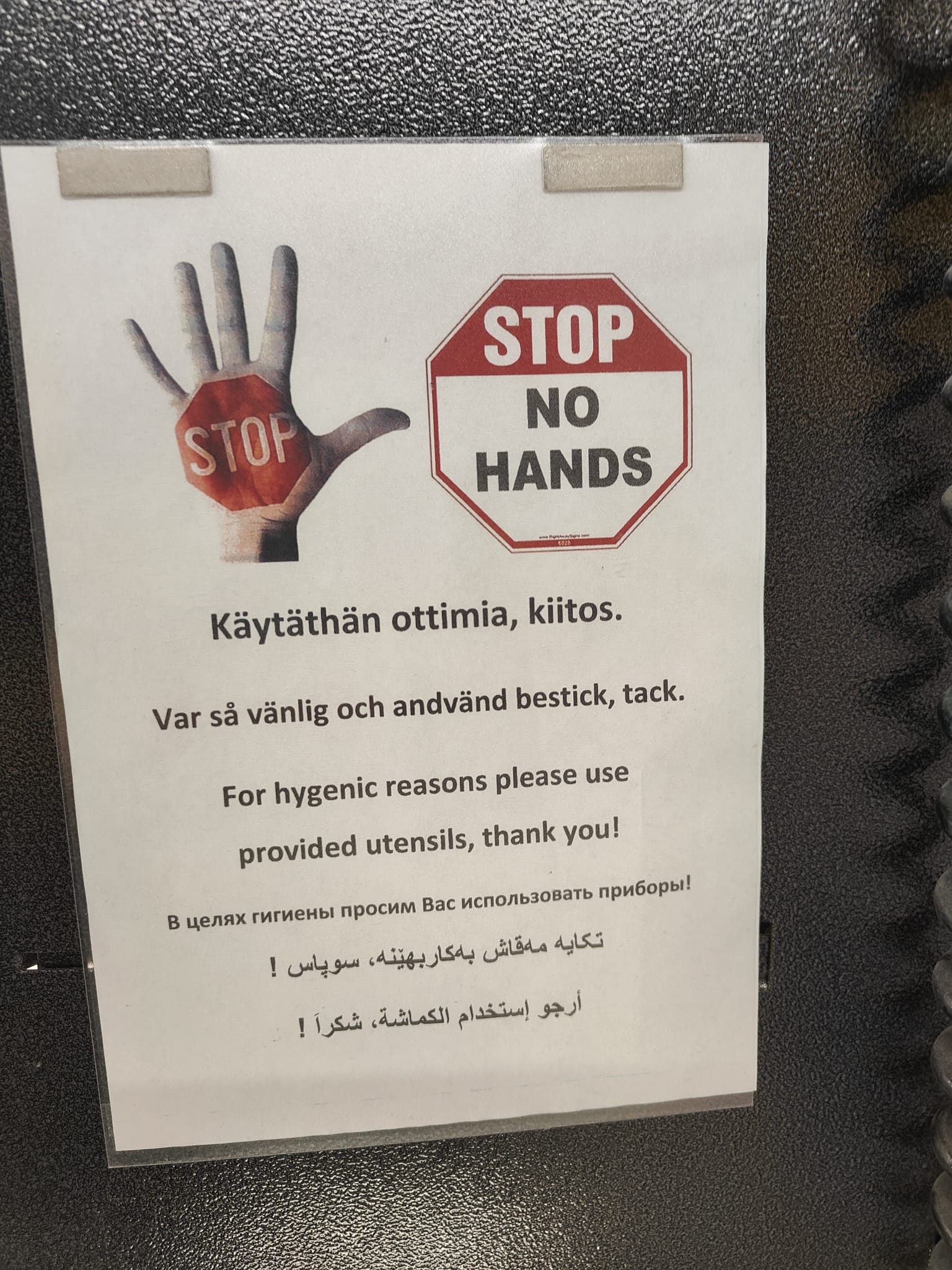
This sign happens to be from the same building as the anti-MCU sign, but instead of the library this one was located at the supermarket downstairs. Specifically, it was located near the candy section where you can pick your own loose candy. And the sign very emphatically is reminding the viewer to use provided utensils instead of bare hands.
We do find the pictorial component, an open hand with a superimposed traffic STOP sign also curiously non-standard, but our focus today is on the language aspect. We start with the common common Finnish-Swedish-English triplet. But instead of stopping at English, we continue with Russian1, Kurdish2 and (standard modern) Arabic1.
According to the Wikipedia statistics, the distribution of most common languages in Finland (counted by percentage of residents with given mother tongue) looks as follows:
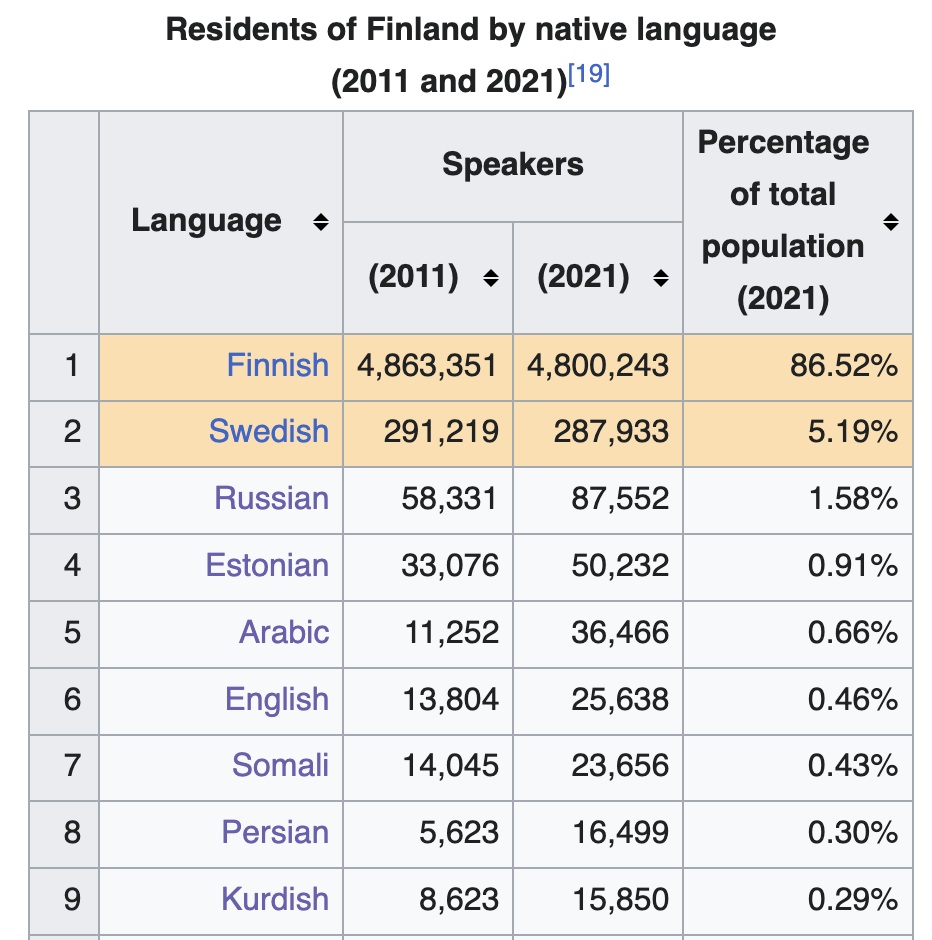
In particular, this choice of languages in the sign does not follow this distribution. It skips both Estonian and Persian completely, and places Kurdish on top of Arabic3. Of course we are here comparing to the language statistics of residents' mother tongues in all of Finland, rather than the language capability of the people frequenting this particular store. But we still suspect that the language choice here is backed by MCU ideas and not just statistical distributions. In particular, note how the Finnish and English (and apparently Kurdish and Arabic) simply as to use utensils, while the English and Russian versions emphasize that this is due to hygiene.
I do not have a strong conclusion here, but note that this was an unusually rich and interesting example in the realm of linguistic landscapes.
-
According to an Iranian colleague. ↩
-
If I had to guess, the sign posters might presume that Estonian people visiting Finland can read either Finnish or English well enough to parse this message. And perhaps the Arabic at the bottom functions as another catchall besides the English text, being a sort of lingua franca in the Middle East, north Africa and the Sahel region. The inclusion of Kurdish is still surprising though, but perhaps I am simply ignorant of the local demographics. ↩