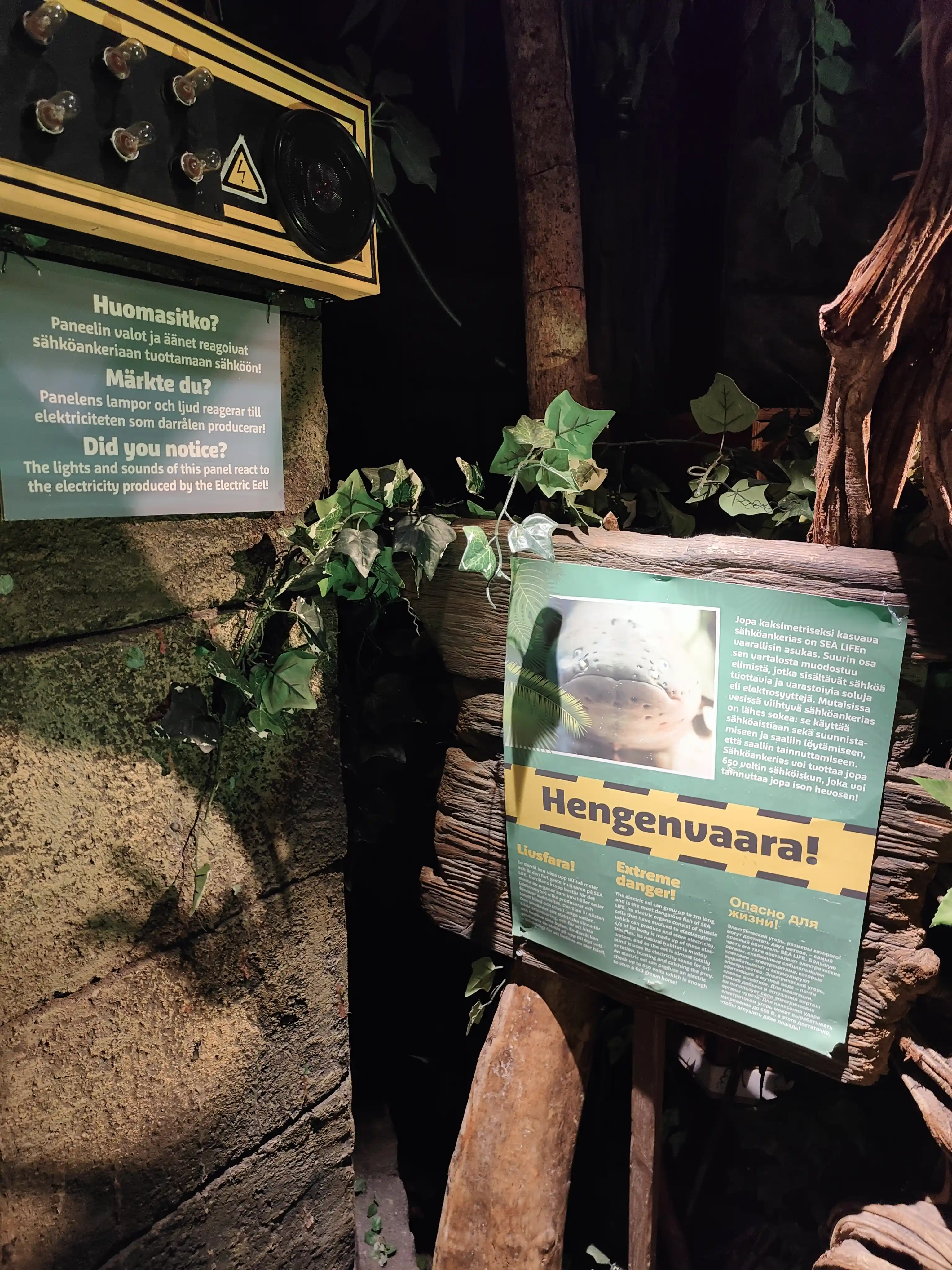
Spotted in an aquarium in Helsinki, Finland, we see here a sign warning about the electric eel. Our interest this time is not in the exact form or style of the poster, but rather on the language selection. All the other signs in the aquarium were in Finnish, Swedish and English (i.e. the "standard triplet" in Finland) but this one sign which warned that the electric eel can actually be lethal had the warning text also in Russian. (And I think it was the sole sign with four languages.)
This again ties very well to Commanding Multilingual Urgency by Chesnut et al.. Either this sign has been produced in a different context from the rest (e.g. a later addition to the signage) and the designers have deemed these four languages to be the most important ones. Or then the sign makers have deemed that people speaking Russian can default to reading English in other signs, but this warning is so crucial that it needs a Russian version included. Trying to meditate on my anecdotal personal observations of Russian stereotypes in Finland, I am not sure if I would deem the stereotypes supporting the idea that "Russian people are more likely to try and grab the electric eel in the aquarium." Very curious.
As another interesting note; the Finnish, Swedish and Russian version call the electric eel as "the most dangerous inhabitant", while the English version calls is "the most dangerous fish". So there is a difference in the level of anthropomorphication here. Also curious.