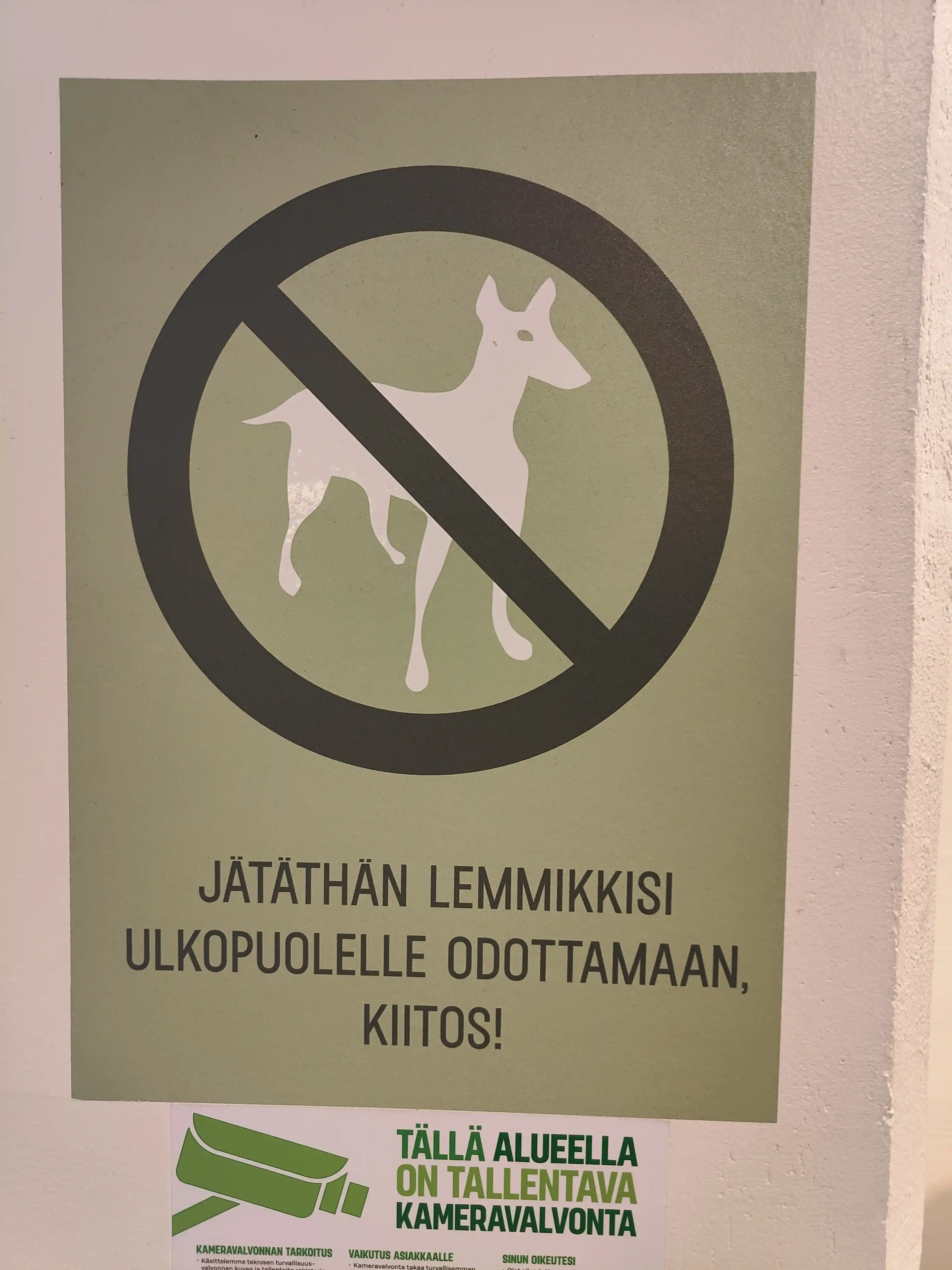
Yet another no dogs allowed sign! Hooray!
This time we are inside a fancy shopping mall called Stockmann in downtown Helsinki. The stereotypical clientele in this multistoried establishment are upper class citizens who do not mind spending a bit of extra for luxury.
To start with, note the gentle green of both the dog sign and the camera sign below.1 From far away it is clear that this is not an angry hazard-colored warning, but a calm informational poster.
The language is exceedingly polite. Again utilizing the Finnish grammatical construction of turning an imperative into a question that implies the wanted behavior: "You'll surely leave your pet outside to wait for you, won't you?" Note also that they directly refer to both you and your pet. This is quite rare, as usually the owner of the dog is indexed in a more implied fashion. Indeed, Halonen and Laihonen point out that the usage of a very generic terrier dog can be considered as a sign of politeness - instead of restricting your dog in particular, commanding your with a pointing finger, the signs use a very generic or indeterminate dog silhouette that forbids all dogs that you just happen to have an example of with you. But here it is your pet that they request to leave outside. I feel that there is a sort of UNO reverse card in play here though, since they refer not to a dog but pet. They do explicitly point to you, but only in the context of specifying that the animal is not just any dog but your darling pet.
We do also note a surprising impoliteness in the sign. Or rather, not an impoliteness in general, but an impoliteness in the setting of this shopping mall. This is due to the fact that in Finland there is a special form of polite addressing where you refer to e.g. your elders in the plural tense. (This is akin to the German "Siezen-Duzen".) This form of politeness is well known and understood, but in practice it is almost archaic. One of the last bastions in my eyes used to be Stockmann, where the salespeople would refer to you as many people, regardless of your age or status. But this dog sign is being very familiar with me by using the singular form!
There is also an interesting juxtaposition with calling the dog "your pet" and then displaying a larger dog, perhaps a doberman. The dog also has a visible eye, not staring directly at you, but the posture, ears and eye seem to indicate alertness. So all in all this sign is a delightful combination of unusual tones in conveying the classical "no dogs allowed" message!
-
I'm working on a longer piece of video surveillance signs where I will elaborate on this point, but note also how the camera is almost parallel. Implying that it is not above you, at least by much, meaning that it does not try to assert dominance over you. Indeed, the valued rich customer should consider the camera not to be someone monitoring them but someone on the same level with them, keeping the place safe from pickpockets and other riff-raff. ↩